

Weird work and trail running
or how to stay sane at the end of a long athletic project

Almost one year ago today, I had surgery to replace half my left knee. Sometime in November or December, I began running again, just 30 seconds at a time, maybe five or six times each outing. This grew to minutes, and then to consecutive minutes. Now, here it is late June and this Sunday I’ll be going out on my last long run ahead of the trail race I’m doing on July 18th. I’ll be out on the mountain for six hours in total.
When I say “the mountain” I mean specifically the route from the northern Greek village of Papingo to the Astraka refuge that sits on a saddle beneath the far end of the Astraka cliffs. The shelter is at about 3,000 meters, and the village is at 1,000m. To the left of the shelter, along that saddle, is a mountain that old maps call Lazarí. If you notice any similarity between that word and my last name, well, my family believes it’s intentional.
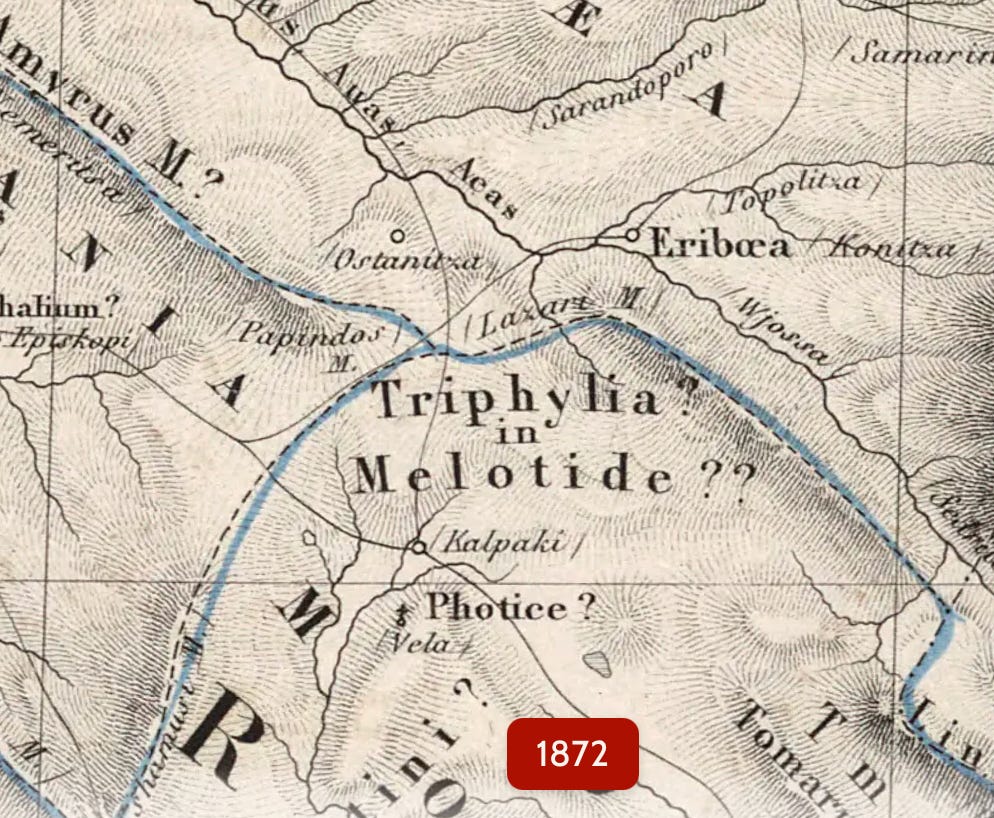
The story goes that some ancestor of mine arrived in Papingo a couple of centuries ago, probably, chased by bandits for the money he had in his saddlebags.1 He escaped by descending into the village of Papingo where they spotted him as a stranger (ah, the trope of stranger comes into town) and asked him his name. Eager to remain free of his pursuers, he didn’t give his name but said instead “what’s the name of that mountain over there?” The villagers told him: Lazarí. “Ha,” he said, “what a coincidence. My name is Lazaridis.” He made up his identity on the spot.2 Or so the story goes.
The Lazaridises at some point had a family with two sons. One of them moved into the house of a childless uncle, and from there continued his own family line. Five generations after that, I’m sitting here in the courtyard where animals used to be penned at night, and then decades later, where my lawyer great-uncle kept a magnificent vegetable garden that fueled the magnificent meals my great-aunt cooked when they came here for weekends. Now, it’s a lawn beneath cherry trees.
It’s never lost on me that when I come here each summer, I do a very different kind of work than my ancestors did. They gardened and harvested and herded. They carried and dug and hefted. But—and this is an important characteristic of the Zagori villages that Papingo is a part of—they also studied. They taught. They wrote and read and analyzed. They became scholars, lawyers, intellectuals. A strange thing for a village in the middle of nowhere that didn’t even get electricity until around 1970 or a paved road until much later.3
So, I suppose that when I sit here and write and edit and work on Galiot Press, I’m not that different from my ancestors who pored over books in multiple languages from the village’s once-copious library. In this sense, I am keeping up the Lazaridis tradition of scholarship and a life of letters.
But there’s that other kind of work, the training work—to wit the six hours I am going to spend on the mountain on Sunday and the many more hours I’ve been spending on the trails around here every day.
This is weird work. It’s some weird stylization of the actual work that running or hiking used to be, here, and still is in many parts of the world. To run or hike or do any sport, really, you’re play-acting work. You’re pretending. You’re not much different from a Lippizaner horse whose dance-like parade movements are no more than exaggerated and trained versions of natural horse behaviors.
I know, I know. It’s a little nuts to be choosing to do a race that will likely take me 15 hours to complete. It’s a little nuts to want to do this race for, among other things, the views and the route when I’m likely to be watching my feet for a lot of the trek, lest I trip and fall. And yet here we are.
Since I started training in December, this race has been a project, something I feel like I’ve been building, just the way one builds a manuscript. I’ve been making something, little by little. I’ve been adding to my strength, endurance, agility, incrementally, the way I add to a manuscript word by hand-written word. The training has consumed a considerable amount of my free time and my mental space, to the extent that I’ve lately found it difficult to work on the actual manuscript I’m revising. There simply isn’t enough time, what with working on an independent press. And there isn’t space in my creative brain for two creative projects.
Because, yes, training for a big race like this one is a creative project. With three weeks left after this Sunday, I feel I’ve built something. The training is a solid, real, finite thing I will have created. Given the cut-off time I must meet at the 21 kilometer mark, there is a chance, after all, that I won’t be allowed to complete the race. You never know. I’m doing my best to be able to make it there by the 4 hours and 45 minute deadline, but on the day, all sorts of things could happen. Right now, the training is the only piece I can guarantee.
The project is the training, not the race.
I’m sitting here in the courtyard, looking up at the Astraka refuge that the race route will reach from the back side, coming up to it and then down again through a huge plateau behind the mountain, and I can see the scar on my left knee. It’s pretty awesome, if you ask me, to know where I was last year this time, and where I am now. I can feel the difference in my strength and agility every time I head out on a trail and remember what if felt like last year.4 No matter what happens on race day, I’ve created something.
OK, but here’s an addendum which is actually kind of the whole point of this post: It is crucially important that—just as with a book—I’m mindful of what it feels like right now, to be at this stage of my life, my month, my days. And to take pleasure in all of that—regardless of an outcome that’s beyond my control. After all, I can (and will) revise the crap out of a book, make it the best I possibly can, and still not be able to get it published. Will my life have changed because of that? Will my days spent on that project have been any less meaningful? No! If I don’t make the cut-off time on July 18th, will all the months I spent training have disappeared? No! All the pleasure I took in getting stronger, feeling agile, in seeing scenery and weather and even the pleasure in plain-old fatigue will still be mine, my project. Sadly, there aren’t enough creatives whose lives and well-being depend on their creations—because it’s nearly impossible to support yourself on just your writing alone. But let’s be honest: for most of us, our creative projects don’t make or break us. Which is why we can be glad for the work, the weird work that we choose to undertake.
My ancestors were traders all through the eastern Balkans, going as far as Odessa. In the 19th century, they more or less commuted to the Romanian city of Turnu-Severin where they and other expats from Papingo funded the building of the bridge over the Danube there.
Another explanation is that he was, of course, already called Lazaridis, a theory that would be supported by the fact that Greek names ending in “idis” come from the Pontic region, not Epirus. Still, because of all the back and forth to Odessa, Epirus indeed has many families named Lazaridis. Go figure.
The historical reason for this goes back to the Ottoman Empire when the Greeks made a special arrangement with the Pasha in power in the province, that they would pay their taxes but be left alone. The Turks were all too happy to skip the long and winding roads up to this region, so the villages of the Zagori had the freedom to build schools—for girls and boys equally—and to keep their own churches.
🧿
The true inspiration
You're an inspiration!